SCALING REGENERATIVE AGRICULTURE THROUGH POLICY AND COLLABORATION
The transition to regenerative farming is key to securing food systems and addressing the environmental impacts of farming. By incentivizing farmers to adopt regenerative farming systems, governments can unlock several benefits such as reduced greenhouse gas emissions, improved water retention, and more resilient rural economies. Well-designed policies that steer towards verifiable outcomes are key to making regenerative farming a mainstream solution for a sustainable future.

What Is Regenerative Farming?
Regenerative farming is a holistic approach to agriculture that goes beyond sustainability; it actively rebuilds soil organic matter by sequestering carbon from the atmosphere. Unlike conventional farming, which often depletes soil and relies on chemical inputs, regenerative farming enhances ecosystem services crucial for farming. By cutting input costs and buffering against extreme weather, regenerative farming also increases farm profitability over time.
How Does Regenerative Farming Produce Multiple Benefits?
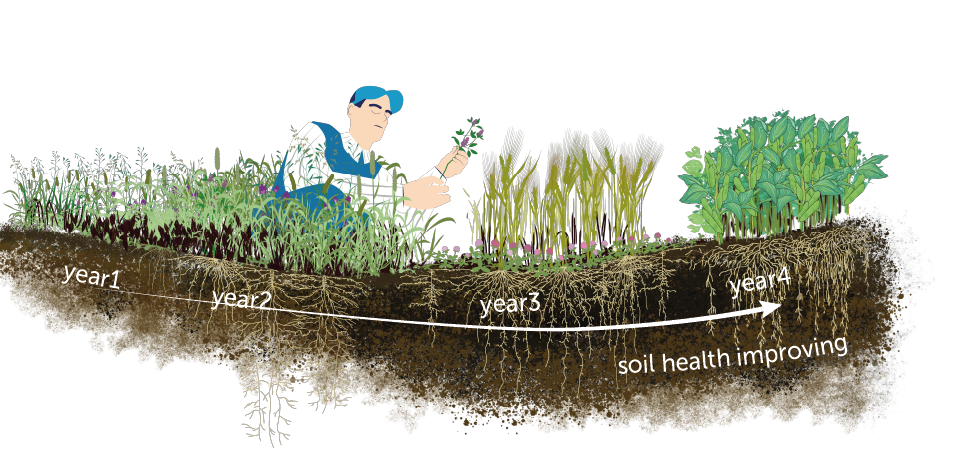
Regenerative agriculture rests on three core principles: minimizing soil disturbance, maximizing biodiversity, and keeping the soil covered and living year-round. These principles are put into practice through a combination of methods that best suit the unique circumstances of each farm. By combining practices such as cover cropping, adding organic matter, reduced tillage, and agroforestry, farmers build farming systems that mimic and support the natural functions of healthy ecosystems.
Soil health sits at the center of regenerative farming, and healthy soil is what allows it to store carbon effectively. Diverse crop rotations and cover crops improve soil health, and when deep-rooted plants are included, they further boost soil carbon sequestration. Well-managed rotational grazing recycles nutrients and stimulates plant growth. Leys (temporary grass or grass-clover pastures) are especially effective at capturing carbon, while cover crops can add substantial carbon to the soil after the main crop is harvested. Together, these practices improve soil health and protect carbon stocks, which in turn enhances water retention and reduces erosion while also supporting biodiversity both above and below ground.
Regenerative practices also tend to reduce farmers’ reliance on synthetic fertilizers and pesticides, which can lower production costs and cut pollution, creating a reinforcing cycle of environmental and economic benefits
Novel Policies Could Support Transition
Turning the potential benefits of regenerative agriculture into real-life outcomes on a large scale requires new approaches to policy design and collaboration between public and private actors. Market-based mechanisms like carbon credit programs, premium pricing for regenerative products, or integrated value chain sustainability strategies could align financial rewards with ecological benefits. Additionally, technical assistance programs, certification standards, and public-private partnerships could lower barriers to adoption.
In the EU, the Common Agricultural Policy (CAP) majorly impacts on how agriculture is practiced. To genuinely support the transition to regenerative agriculture, the CAP needs a comprehensive revision. Current policy instruments that subsidize practices and methods do not support holistic farm management and do not produce the environmental outcomes they aim to produce.
Designing and piloting result-based subsidies that reward farmers for measurable outcomes is a prudent next step. Outcome-based subsidies are flexible and effective as they allow farmers to freely choose the suitable means to reach the desired result within the unique context of each farm.
The EU’s new Carbon Removals and Carbon Farming Certification Framework (CRCF) enables standardized certification of carbon removal units for the market. This could create additional revenue for farmers and benefits for the value chain by putting a verified value on real climate impact — but only if it’s properly aligned with the CAP, for example by coordinating with outcome-based CAP payments.
One possible outcome-based CAP payment could be aimed at increasing the net primary production of the fields. Net primary production is measurable at scale. Increasing net primary production brings several environmental co-benefits, including increased carbon sequestration and decreased nutrient run-off. Read more about how this model could work.
The Role of MRV: Ensuring Trust and Transparency
To scale regenerative farming through business and public policy, we need reliable data. Accurate carbon assessments are essential for sustainability strategies, greenhouse gas inventories, and developing finance as well as new climate and agricultural policies.
Soil carbon Monitoring, Reporting, and Verification (MRV) systems track the impact of regenerative farming, building trust among farmers, policymakers, and consumers. The EU Carbon Removals and Carbon Farming (CRCF) Regulation standardizes and enforces MRV across the EU carbon farming and removals market.
MRV systems can help farmers understand the impact their actions have on the carbon sequestration of their fields, locate problems and make informed decisions. Businesses in the food industry can use it to understand and reduce their carbon footprint. Governments can create incentives and regulation.
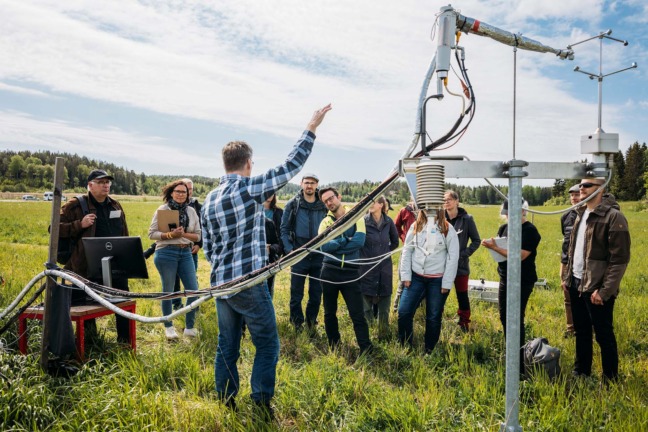
The Carbon Action MRV is a system for monitoring soil carbon balance in agricultural fields. It uses satellite data to calculate daily plant growth and photosynthesis. Soil carbon is calculated by determining the amount of plant biomass accumulated during the year, subtracting the amount removed with the harvest, and adding the amount of carbon introduced through manure and other sources. The Yasso soil model is used to estimate how much carbon is released. The model’s behavior has been adjusted and validated using continuous carbon flux measurements and soil samples.
The Carbon Action MRV provides accurate, annual field-parcel-specific carbon balance results. The system is automated and designed for large-scale applications, analyzing hundreds or thousands of fields. The system follows open science principles, ensuring full transparency and documentation to support third-party verification. It is designed for international use and relies on EU Copernicus Land Service satellite data, accessed via the Finnish Meteorological Institute’s Arctic Space Center.
The Carbon Action MRV system is useful on several levels, having potential applications in policymaking, the planning of agricultural practices, and climate change mitigation. In addition to providing decision-making support to farmers and food-chain companies, the system can be used to determine the baseline for a carbon removal certification system, as well as improving national greenhouse gas inventories.
The system is developed by the Finnish Meteorological Institute.
The possibilities of value-chain collaboration to innovate scalable solutions
Without the support of the value chain, transitioning to regenerative agriculture is challenging for the individual farmer.
Through collaboration, pioneer farmers and businesses can enable transitioning to regenerative agriculture despite sub-optimal policy environments. By supporting the adoption of regenerative agriculture, food companies are actively mitigating climate and financial risks associated with their business.
Systematic multi-actor collaboration within similar framework contexts provides food system stakeholders an ecosystem to innovate and pilot systemic solutions for i.a. incentives, metrics and data management and cropping systems and market optimization. These can help introduce joint systemic and scalable solutions to accelerate transition to regenerative agriculture and concretize the benefits throughout the value chain.
A concept developed in CREDIBLE project elaborates the above values of territorial multi-actor collaboration. Specifically, with respect to carbon farming schemes and carbon removal crediting, report D1.4 outlines a blueprint for coordinated stakeholder action that takes regional specifities into account.


CONTACT US

Kaj Granholm
Project Manager, Regenerative Agriculture, EU affairs